
Are you having any trouble hatching duck eggs? So were we. In 2024 our hatch rate was 38.6%. In 2025 we made one change to our incubation protocol and our hatch rate jumped to 46.1%. That’s nearly double the improvement most producers would expect from buying a better incubator or adjusting their temperature settings. We didn’t change either of those things. We just started spraying our eggs.
This post explains exactly what we did, why it works biologically, and how you can replicate it with equipment you already have.
What is egg spraying and why does it matter for hatching duck eggs
Duck eggs are different from chicken eggs in one critical way — in nature, a duck hen leaves the nest to swim and returns with wet feathers. That moisture and the brief cooling period when she’s off the nest are not accidents. They are part of the developmental process. The eggs need that humidity fluctuation to hatch correctly.
Most incubators are designed primarily for chicken eggs, which don’t need that moisture spike. If you’re running duck eggs in a standard incubator and not compensating for this difference, you’re missing a key part of what the eggs need.
Spraying — misting the eggs with lukewarm water — mimics the hen returning to the nest with wet feathers. It briefly raises surface humidity, cools the eggs slightly, and supports the membrane development that allows the duckling to pip and hatch successfully.
Exactly what we changed in 2025
In 2024 we did not spray eggs. We figured that it wasn’t worth the risk of forgetting to turn the incubator back on. None of our batches got sprayed. Our hatch rate across 33 batches and 4,221 eggs set was 38.6% of fertile eggs.
In 2025 we committed to a consistent protocol across every batch: spray every egg once daily from day 7 through day 24 with cool water, then stop for lockdown. That’s it. Same incubator, same temperature settings, same humidity baseline. The only variable was consistent daily spraying during the active development window. We didn’t spray with lukewarm water and wait for the eggs to cool becasue again, we forget to tun things back on. So we sprayed with cool water to do the cooling.
Across 29 batches and 6,584 eggs set our hatch rate rose to 46.1% of fertile eggs — a gain of 7.5 percentage points, or a 19.5% relative improvement. This is still not a great hatch rate comparexd to some farms, we know this.
One practice change. Nearly double the relative improvement of anything else we tried.
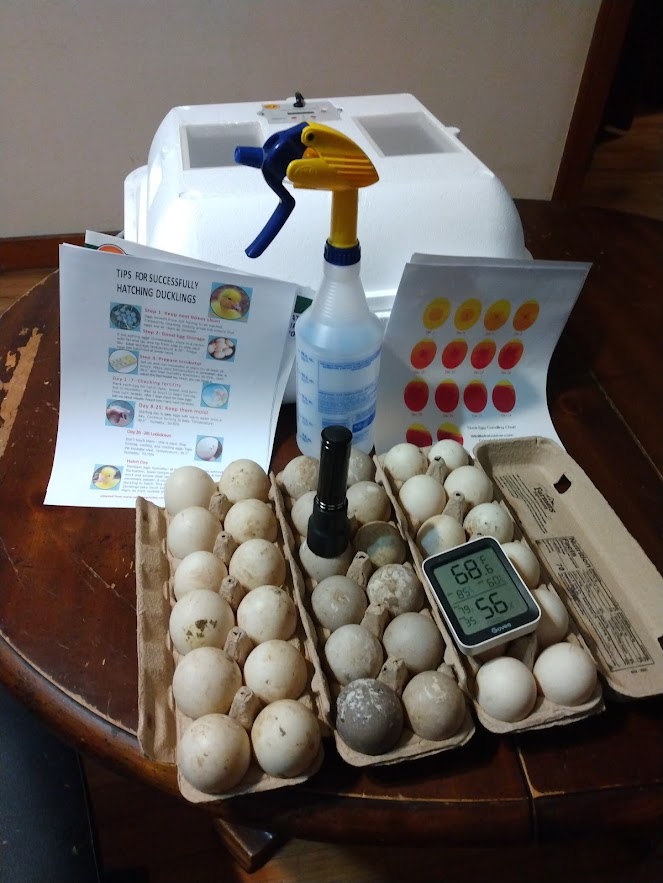
How to spray duck eggs correctly
It’s probably even better to use lukewarm water. Use a clean spray bottle filled with lukewarm water — not cold, not hot, just slightly warm to the touch. You can leave the spray bottle in the incubator if you want to keep the water the right temperature. Open the incubator once per day and mist all eggs lightly. You want the surface damp, not soaked. If you can remember, you can wait until the eggs feel like slightly cool to the touch before strarting the incubator back up. Close the incubator and let it return to temperature.
Start on day 7. The first week of incubation is critical for early vascular development and you don’t want to spray then because you don’t want to stress the eggs and their tiny little blood vessels during that window. From day 7 through day 24 spray daily without fail. Stop completely when you go into lockdown on day 25 — you don’t spray during the hatch itself.
Some producers also let the eggs cool for 5 to 10 minutes during the spray session, which more closely mimics the hen leaving the nest. We did not do this systematically in our 2025 data so we can’t confirm the additional benefit, but experienced duck hatchers report it helps with particularly difficult breeds.
A note on our data
This is two years of production records from one operation — 62 batches total, 10,805 eggs set, primarily Cayuga heritage breed at Urban Wildfinds Farm and Forage in Kansas City, Kansas, under USDA SARE grant FNC25-1484. The improvement we saw is real and consistent across the 2025 season but we are not claiming this is a controlled scientific trial. Other variables may have contributed. We will have three years of data after the 2026 season closes and will update this analysis at that time.
That said — a 19.5% relative improvement in hatch rate from a free practice change that takes 5 minutes per day is worth trying regardless of whether the exact numbers hold in your operation.
What this means for your bottom line
At our cost structure — $1 per egg, $7.50 average sale price per duckling — the improvement from 38.6% to 46.1% hatch rate means approximately 56 additional ducklings per 1,000 fertile eggs set. At $7.50 average that’s $420 additional revenue per 1,000 fertile eggs for 60 seconds of daily work.
The spray bottle cost us $2.
Other posts in this series
This is the second post in our six-part series on data-driven duck production. If you missed the first post on when to set duck eggs for peak fertility, read it here. Coming up: why summer hatch rates fail and it isn’t your incubator, the economics of hatching by season, and the October fertility comeback.
If you are a duck producer in the central states and want to join our producer network or list your birds on our marketplace, sign up here.
This post is part of USDA SARE grant FNC25-1484, supporting USA Duck Team LLC’s heritage breed duck genetics operation and regional producer network based in Kansas City, Kansas. Corinna West, Managing Member, USA Duck Team LLC.