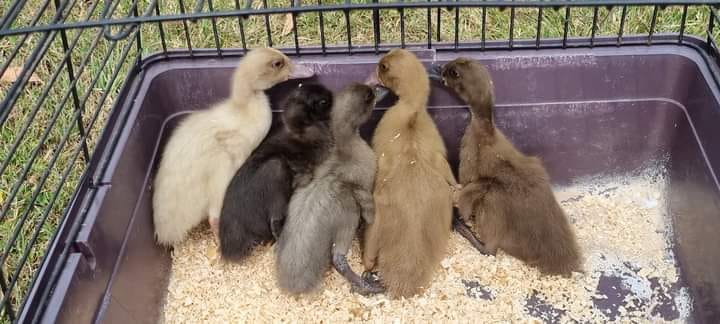
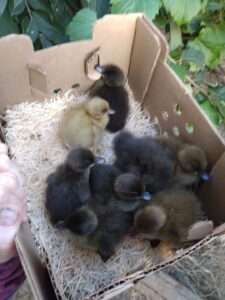
Have you ever heard of a Blue Cayuga? Well, we call them blue solid dusky ducks. Every spring we hatch a box of ducklings that stops people in their tracks. Black ones, blue-gray ones, silver ones, all solid colored with no white bib, no eyestripe, no patchwork. Just clean, rich color from bill to tail. People ask us what breed they are, and the honest answer is: we call them blue solid ducks and silver solid ducks, and here is why that matters.
It all starts with the dusky mallard gene
Most domestic ducks trace back to the mallard, and the mallard pattern — brown body, green head on the drake, eyestripes on the hen, white bib — is the default. The dusky mallard gene suppresses that pattern and replaces it with solid color. A duck with black plus the dusky mallard gene is solid from head to tail regardless of what color that is.
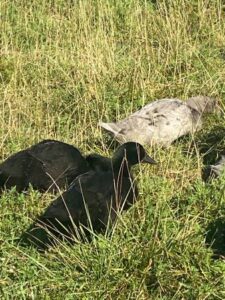
The Cayuga is the most well known black solid dusky mallard duck in North America — solid black, iridescent green in the right light, no bib. Our blue solids and silver solids carry the same dusky mallard gene. When we candle eggs and check underwings on grown birds, the dusky birds have gray or green underwings. The non-dusky birds have brown underwings with the beginning of the wild mallard pattern. We only keep the dusky ones in our breeding program. Blues and silvers carry the brown underwing the same as black Cayugas do.
What blue and silver actually mean genetically
Think of black as the base color. Dilution genes lighten that base in different ways. One copy of the blue dilution gene on a black dusky bird gives you blue — a slate blue-gray bird with clean solid color. Two copies of the blue dilution gene gives you silver — a lighter gray bird. This is why blue birds are unpredictable breeders. A blue bird carries one copy of the dilution gene. Breed two blue birds together and you get a mix of blacks, blues, and silvers in the same hatch depending on which combination of genes each duckling inherits. Breed blue to black and you get mostly blacks and blues. Our five year program has been running blue to black specifically to concentrate the dusky gene and deepen the richness of the blue expression while keeping the solid pattern.
Why we don’t call them Blue Cayugas
Some breeders use the term Blue Cayuga for birds like ours and we understand why — the body type, the carriage, the solid dusky pattern all look like a Cayuga in a different color. But Cayuga is a defined breed with a breed standard maintained by the American Poultry Association, and our foundation birds came from the Jamesport Missouri auction with unknown origin. We don’t know their full breeding history and we aren’t going to claim a breed designation we can’t document. It also just stop arguements. People can get mad at the term Blue Cayuga but no one can argue that what I have is a blue solid duck.
European breeders have a useful term for this color class — Blue Forest, named after the Forest duck which is a black dusky breed developed in Belgium as early as 1905. Chris Ashton’s comprehensive guide to domestic duck genetics covers the Blue Forest and the full range of dusky dilution colors in detail if you want to go deeper on the science. Our birds fit that color class even if we didn’t start there intentionally.
We call them blue solids and silver solids because nobody can argue with a description. The color is real, the solid pattern is real, the five generations of selective breeding are real. The name is just a name.
Why solid matters for homesteaders
A duck with bibbing — white feathers on the chest or throat — is not a flaw. Blue Swedish are bibbed by standard and they are excellent homestead ducks. But if you want a flock that looks intentional and uniform, bibbing creates inconsistency. Our blue and silver solids throw consistent solid colored birds because we have been selecting for the dusky gene for five years. You know what you are getting.
They are also dusky mallard birds which means their meat is darker and richer than a Pekin. If you are raising ducks for both eggs and meat, a solid dusky bird gives you the full package — striking appearance, good egg production, and flavorful dark meat. In addition, the blues process out a lot neater than blacks. Also, customers like buying a range of colors so that they can identify birds or have a different palette to look at in their yard.
What we are working toward
Five generations in, our blue solids are distinctly different from where we started. The blue is deeper and more consistent. The silver expression is clean. We are also doing smaller scale work with chocolate duskies, which carry their own dilution combination and tend toward a smaller frame than our blues.
The goal is not to create a named breed. It is to produce the best solid colored dusky ducks we can from the genetics we have, document what works, and make those birds available to homesteaders and small farmers who want something different from the standard hatchery options.
If you are interested in blue solid or silver solid ducklings, hatching eggs, or breeding stock, find us on the USA Duck Team marketplace. We hatch every Thursday through the spring season.
Reference: Ashton, Chris. Domestic Duck Breeds. Excellent source for detailed genetics of dusky mallard dilution colors including Blue Forest and related color classes. Corinna West, Managing Member, USA Duck Team LLC — Urban Wildfinds Farm and Forage, Kansas City KS.