If you have ever set a mixed batch of duck eggs in the incubator and wondered what was going to hatch out, you are not alone. For years we collected data on our flocks to answer exactly that question. What we found is that the outside of the egg tells you quite a lot about what is on the inside.
Over five breeding seasons and thousands of eggs across multiple farms in our network, we tracked egg shell color against the phenotype of the duckling that hatched. The patterns that emerged are consistent enough to use as a practical breeding and selection tool.
Why This Matters in a Mixed Flock
Most small farm flocks are not perfectly sorted by breed. You might have Cayugas running with Anconas, or Welsh Harlequins, or birds of unknown background. When you collect eggs to incubate, you are picking from a mixed pool. If your goal is to produce Cayuga-type birds, you want to know which eggs to set and which to leave out.
The key insight from our research is this: you do not have to change your flock to improve your hatch. You just have to be smarter about which eggs go into the incubator. Egg selection at the tray is the quality control step.
This is especially important for the scattered-site hatchery model we use at USA Duck Team, where network farms have varying flock compositions and we need a low-tech way to maintain breed quality without requiring every farmer to run a perfectly controlled pen.
What the Data Shows
We classified eggs by shell appearance into several categories and tracked what phenotype hatched from each. Here is what we found across more than 500 eggs with usable phenotype data:
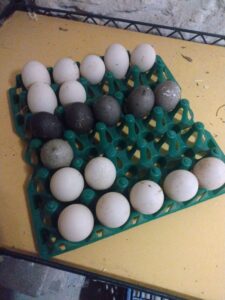
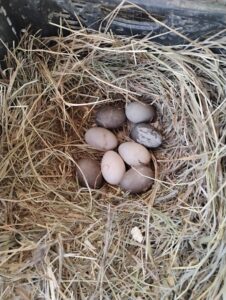
Black shell eggs are the strongest predictor of all-black Cayuga phenotype. In our dataset, 67% of ducklings from black shell eggs were all-black Cayuga. If you want traditional Cayuga birds, black eggs are your best bet. We would classify all the eggs in the center of this tray as “black”:
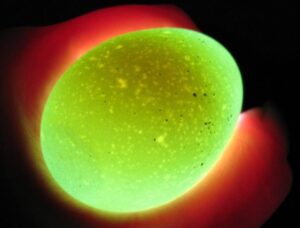
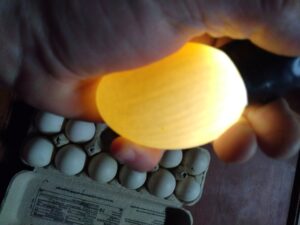
Solid eggs (eggs that appear opaque when candled, regardless of surface color) showed an even stronger signal at 77% all-black phenotype. We used this method primarily in 2021 before switching to naked-eye shell color classification, and the results were the cleanest in the dataset. The opacity when candled reflects the same high melanin concentration that produces all-black offspring. They look like this when candled. Now, this image is actually a chicken egg, but when you candle duck eggs, most will look clear when candled whereas a “solid” duck egg will have an opaque or non-see-through appearance to it like a chicken egg.
Silver eggs predict all-blue birds at 45%. If you are selecting for blue Cayugas or blue-based genetics, silver shell is your indicator. We don’t have a picture of this, but the “silver egg” is an egg that is whiter that white. It is whiter than all the other eggs in an egg set. It will pop up for being more white.
Magpie pattern eggs (mottled or smudged pigment on an otherwise white shell, visible to the naked eye) indicate a heterozygous pied hen. About 57% of pied-type output across all pied-adjacent phenotypes comes from magpie shell eggs. If you are trying to produce Ancona-pattern birds intentionally, magpie eggs are what you want. If you are trying to keep your hatch pure Cayuga, these are the eggs to pull out. This is what that looks like, notice the mottling or chunky color pattern on the outside of the eggs.

White eggs from a Cayuga flock tend to produce the lowest rate of all-black offspring and the highest rate of pied and bib phenotypes. White shell in a Cayuga context often indicates a hen carrying dilute or pied genetics. These are the eggs we recommend setting aside if your goal is all-black Cayuga production. We classified anything not pigmented or black tipped as a white egg.
Gray eggs were the darker colored eggs coming out of Cayuga pens that weren’t quite black. There is a judgement call to make about what is gray and what is black. That looks like this. The eggs are labeled by hen because of the one year we could tell our girls’ eggs apart. If you look at the Jada eggs on the right, they are grey, whereas the Pinkie eggs in the center on the left might be more black. This is the hardest judgement call in our data set.
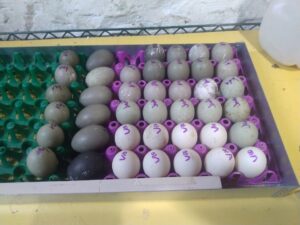
Black tip eggs on the other hand showed a strong percentage of Ancona babies. Here is what the black tip egg looks like, this is anything with black pigment on the pointy end of the egg. This is an actual nest shared by several of our ducks in the coop, and the center 3 eggs show the black tip pattern, whereas the top two eggs would be black or grey, and the bottom two eggs are grey. These eggs are most likely eggs laid by three or four different ducks.
Diagonal eggs showed a diagonal stripe from candling. Our theory was that is was tied to the harlequin gene but it turned out not to be a strong signal. We had to discontinue this method due to light senstivity.
Now, here is what wer found about how to identify what will hatch out of the egg:
Egg shell appearance as a breeding selection tool. Data from USA Duck Team hatch records 2021–2025. Black shell produces 67% all-black Cayuga. Solid (candled opaque) produces 77%. Silver predicts all-blue at 45%. Magpie shell indicates pied genetics.
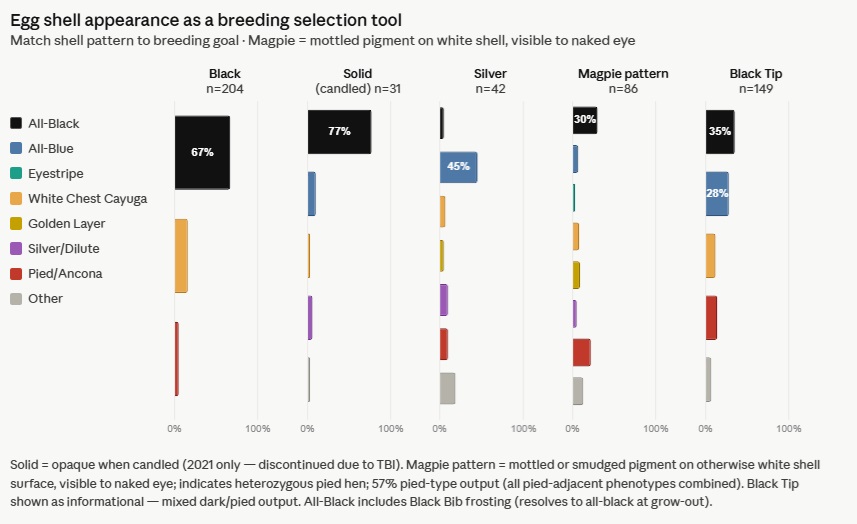
This chart shows five of the types of duck egg shells along the top that showed a strong signal— Black, Solid (candled), Silver, Magpie pattern, and Black Tip. Each bar in the chart shows what phenotype, or color pattern, hatched out of that type of egg. The wide dark bar means most of those ducklings were all-black Cayuga. A wide blue bar means most were all-blue. Narrower colored bars below mean smaller numbers of other patterns like pied or bib.
Reading left to right: Black eggs (n=204) produced mostly all-black birds — 67% of ducklings were the classic all-black Cayuga. Solid eggs that appeared opaque when candled (n=31) were even stronger at 77% all-black. Silver eggs (n=42) shifted toward all-blue birds at 45%. Magpie patterned eggs — those with mottled or smudged dark pigment on a white shell — produced a mix of pied-type patterns, which tells you the hen who laid that egg is carrying pied genetics. Black Tip eggs (n=149) produced a mixed output of dark and pied birds.
The bottom line: the darker and more solid the egg shell, the more likely you are to get a true all-black Cayuga duckling. The whiter or more mottled the shell, the more likely you are to get a pied or mixed-color bird.
The Eyestripe Finding
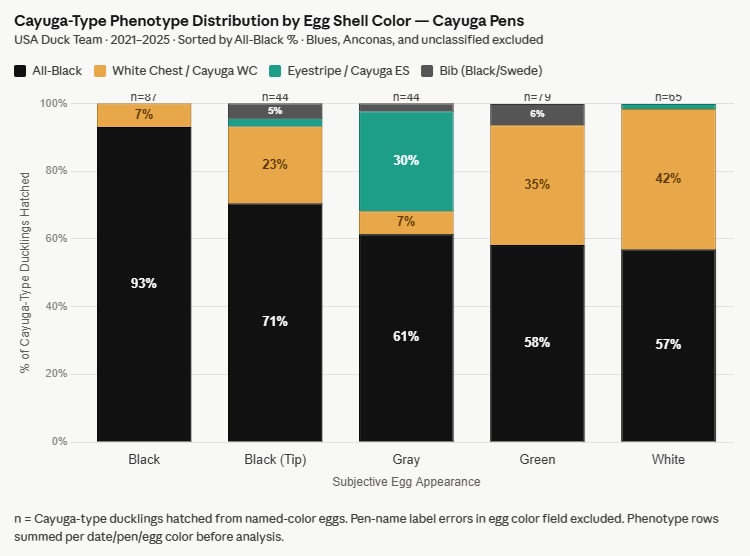
One of the cleanest signals in the entire dataset was for the eyestripe phenotype. Eyestripe birds, which show a dark stripe across the face at hatch, came 93% from gray shell eggs. This was the strongest phenotype-to-shell correlation we found. If you are seeing a lot of gray eggs in your incubator and wondering what they produce, the answer is mostly gray-type and eyestripe birds. This is our data set from all Cayuga pens:
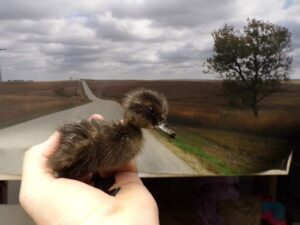
This is what an eyestripe Cayuga duckling looks like, and we found that the ducklings with eyestripes grow out to have “wild leakage,” which is a brown underwing showing the presecence of the wild mallard gene instead of the dusky mallard gene which give more breed standard birds.
How to Use This on Your Farm
You do not need a spreadsheet or a genetics background to apply this. Here is the practical decision tree we use when sorting a mixed egg set:
Set these eggs if your goal is all-black Cayuga production:
- Black shell eggs
- Gray shell eggs
- Green shell eggs (solid performers with good Cayuga output)
- Eggs that candle opaque/solid
Set these eggs if your goal is pied or Ancona-pattern production:
- Magpie pattern shell (mottled or smudged on white)
- Black tip eggs (mixed dark/pied output, produces Ancona-type birds)
Consider setting aside:
- White eggs from a Cayuga flock (lowest all-black prediction, highest pied output)
- Diagonal-patterned shells (does not predict bad phenotype but may carry unwanted recessives in a Cayuga program)
This layered selection approach means that even in a mixed network flock where you cannot control which hens are present, you can still produce a hatch that is predominantly the phenotype you are targeting. That is the power of egg selection as a quality control tool.
An Important Note on White Chest Cayuga
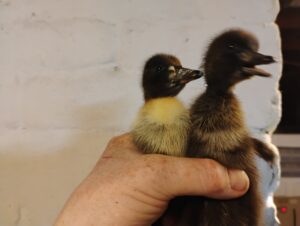
One phenotype classification that causes confusion is White Chest Cayuga. These birds hatch with white chest frosting but resolve to all-black at grow-out. They belong in the all-black category for breeding purposes and are not the same as a Black Bib, which is a persistent white marking that does not grow out. If you are evaluating your hatch results and sorting phenotypes, keep these two separate. We corrected this classification in our own dataset partway through the research and it changed some of our numbers. You can see it here in this image: The baby on the right will grow out of the white “frosting” and turn into a solid black duck. Whereas the baby on the left will always have a white chest. There is a difference between bibbing and frosting. Frosting is OK, and might even predict stronger green sheen, whereas bibbing will end up being a DQ for a Cayuga.
What About Egg Color Change Over the Season?
Cayuga egg color changes as the season progresses. Early season eggs from the same hen can be nearly black, while late season eggs from the same hen may be gray or even white. Does this affect the phenotype prediction?
Yes, somewhat. The shell color reflects pigment deposition at the time the egg was laid, not the hen’s underlying genetics. A hen who lays black eggs in March and gray eggs in July is the same hen with the same genetics. Her late-season gray eggs will still produce higher all-black rates than a different hen who lays white eggs all season long, but not as high as her own early-season black eggs.
This means egg selection works best when done on a current basis. Sort your eggs by the color they are right now, not by what the hen laid last month. Early-season eggs from a good Cayuga hen are your strongest selection material.
For more on how egg color changes across the season and what it means for your flock, see our post on hatch rate by individual hen where we tracked these patterns within the same pen across a full breeding season.
The Broader Research Context
This research is part of a five-year data collection effort at USA Duck Team covering hatch records from multiple farms in our scattered-site network. Our co-investigator Jennifer Reynolds of Lincoln University Cooperative Extension has been involved in the data collection and we are working toward a peer-reviewed publication on these findings.
The practical implications go beyond just egg selection. If egg shell color is reliably predicting offspring phenotype, it means the shell pigmentation pathway and the feather pigmentation pathway share underlying genetic architecture. That is interesting from a genetics standpoint and has implications for how we think about selecting breeding stock in heritage duck breeds.
The genetics of duck plumage color are more complex than in chickens, and there is relatively little published research specific to Cayuga or Ancona genetics. Our dataset is one of the larger field-collected records of phenotype outcomes by egg color in heritage ducks, and we hope to contribute it to the broader literature.
For background on the USDA programs that support small heritage poultry producers like our network farms, the SARE Farmer/Rancher Grant program funds exactly this kind of producer-led research that does not typically make it into university lab settings.
Get Hatching Eggs from Tested Lines
If you want to hatch Cayuga eggs from hens with documented phenotype prediction records, our network farms offer hatching eggs for local pickup across Missouri and Kansas. Our headquarters flock in Kansas City, KS produces eggs from lines including Speck, Violet, and Jada, whose individual hatch rates and phenotype outputs we have tracked across multiple seasons.
Find farms near you and browse available hatching eggs at usaduckteam.com.
By Corinna West, USA Duck Team · Kansas City, KS
Research supported by North Central SARE Farmer/Rancher Grant FNC25-1484
USA Duck Team is a network of heritage duck farms across Missouri and Kansas specializing in Cayuga and Ancona genetics. Our research is supported by North Central SARE Farmer/Rancher Grant FNC25-1484 and the Lincoln University Innovative Small Farmers Outreach Program. For questions about this research or our breeding program, contact Corinna West at corinna@usaduckteam.com.