
Duck egg fertility is the variable most producers blame last and should investigate first. Before you question your incubator settings, your humidity, or your hatch technique, the real question is whether your eggs were fertile to begin with — and what drove that number up or down. After two years of records across 10,805 eggs set at USA Duck Team and our partner farm network, we have real data on what actually moves duck egg fertility, and a candid caveat about what the data can and can’t tell us.
What the data shows about duck egg fertility
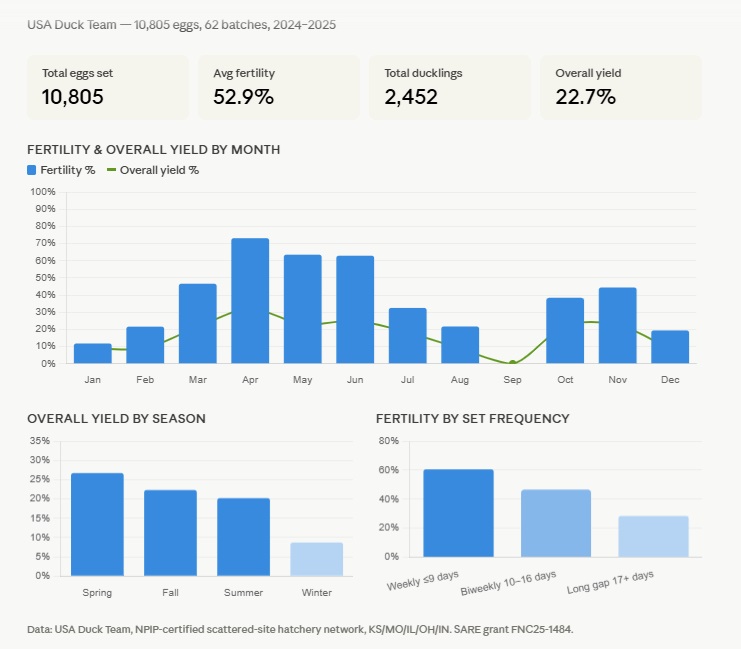
When we sorted our hatch records by the gap between set dates, a clear pattern emerged. Batches set within nine days of the previous set — what we call weekly setting — averaged 60.5% fertility. Batches set ten to sixteen days out averaged 46.5% fertility. Batches set after a gap of seventeen days or more averaged just 28.4% fertility. Every additional week you wait to set, you lose roughly 15 percentage points of duck egg fertility.
Hatch rate of fertile eggs — the percentage of candled-fertile eggs that actually hatch — moved in the opposite direction, slightly improving with longer gaps. This is not because old eggs hatch better. It is because when you candle at day seven to ten and pull the infertiles, you are removing the failures before they count against your hatch rate. Longer gaps mean more infertiles pulled, so the fertile-only count looks cleaner. The overall yield — ducklings out divided by eggs set — is the number that matters, and it tells the honest story: weekly 24.5%, biweekly 22.0%, long gap 14.5%.
How setting frequency affects duck egg fertility
Before you conclude that every producer should set weekly, there are real reasons to set less often. Managing fifty ducklings a week is actually harder than managing one hundred every two weeks for many small producers. Customer coordination, brooder space, age cohort tracking for processing, and the simple sanity of having a week off from hatch day logistics all push toward biweekly setting. At USA Duck Team, we set weekly during the busy spring season and slow to every two weeks as production drops off in summer and fall. That rhythm is a legitimate management decision, not a failure to optimize.
There is also an incubator efficiency argument for weekly setting that is worth noting. If you set weekly, the day you move eggs to lockdown and clear the setter, fresh eggs go straight in. The machine runs continuously at capacity. With biweekly setting, the setter sits partly empty for a week between batches. For producers running tight on incubator space, weekly setting gets more throughput from the same equipment.
Why season and set frequency are hard to separate
Here is the honest caveat that any serious reader of this data deserves to know: in our dataset, set frequency and season move together. We set weekly in spring when duck egg fertility is naturally at its peak, and we slow to biweekly in summer and fall when fertility is already declining. This means we cannot fully separate the effect of egg age from the effect of season on fertility in our records. The biweekly batches are also more likely to contain eggs from older birds later in the laying cycle, which compounds the problem.
Our seasonal analysis shows this clearly. Spring batches (March through May) averaged 65.1% duck egg fertility overall. Summer batches (June through August) averaged 46.5%. Fall batches (September through November) averaged 41.7%. Winter was 17.9%. The fertility drop from spring to summer is steep and happens fast after the June solstice, driven primarily by photoperiod effects on drake fertility in Mallard-derived breeds. Ducks retain more seasonal reproductive biology than chickens, and that biology does not care about your incubator schedule.
A controlled study that held season constant while varying set frequency — setting weekly and biweekly simultaneously from the same flock across the same calendar window — would be needed to isolate the egg age effect cleanly. Our data supports the hypothesis that fresher eggs hatch better, and the biology of egg storage is consistent with that conclusion, but our records alone cannot prove it independent of seasonal variation.
April is peak duck egg fertility month — by a wide margin
The monthly breakdown is worth looking at on its own. April is the clear peak month in our two-year dataset: 73% fertility, 44% hatch rate of fertile eggs, 32.1% overall yield. That is more than three times the overall yield of January (8.9%) or December (8.5%). If you are going to push hard on incubation in any month, April is it. The data also shows a meaningful dropoff from April into May and continuing through June, which means the window of peak duck egg fertility is narrower than most producers assume. Setting eggs aggressively in late March and April and slowing down by late May is consistent with what the biology is actually doing.
How to use this data on your own farm
Set as frequently as your customer base and management capacity allows, especially in April and early May. If you are choosing between weekly and biweekly, understand that biweekly costs you roughly two to three percentage points of overall yield on average, but that cost is real and compounds across a full season. In our network, a producer setting 400 eggs biweekly instead of weekly across a spring season is leaving approximately eight to twelve ducklings on the table per month relative to weekly setting at the same duck egg fertility baseline.
Candle faithfully at day seven to ten and pull infertiles promptly. This matters regardless of set frequency because infertile eggs in lockdown consume humidity and space that developing eggs need.
Do not set eggs in January or February unless you have a specific reason — a custom order, a breed you need to advance in the season, or supplemental lighting you are running to extend fertility. The data shows those winter batches are a poor return on incubator time and energy.
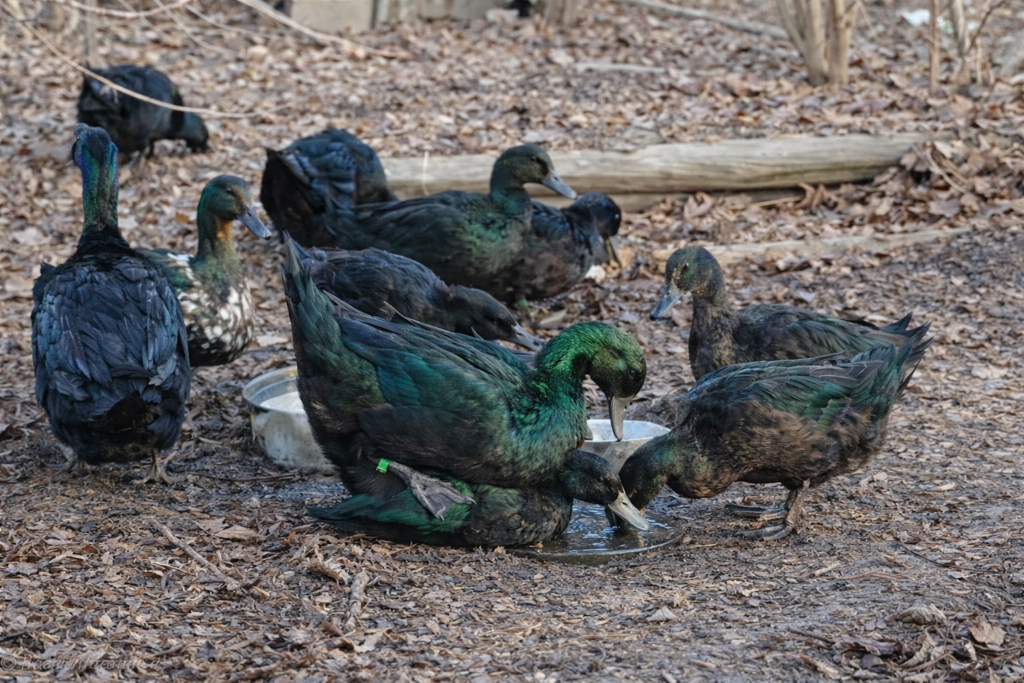
And finally, track your own data. Our dataset is two years from one network in the central United States with heritage breed Mallard-derived ducks, primarily Cayugas. Your flock, your climate, and your management will produce different numbers. The pattern is likely to hold — fresher eggs in peak season with consistent setting will outperform stale eggs set sporadically — but the exact percentages are yours to measure.
About this dataset
These findings come from two years of hatch records at USA Duck Team’s NPIP-certified scattered-site hatchery network, covering 10,805 eggs set across 62 batches from February 2024 through December 2025. USA Duck Team is funded in part by a North Central SARE Farmer/Rancher Grant (FNC25-1484). Data was recorded by Corinna West, Managing Member, Urban Wildfinds Farm and Forage, Kansas City, KS.